
Tokenization’s Identity Crisis: Why Everyone Thinks “RWA” Means Bonds When It Could Mean Everything
 Feb 10, 2026 · Silver
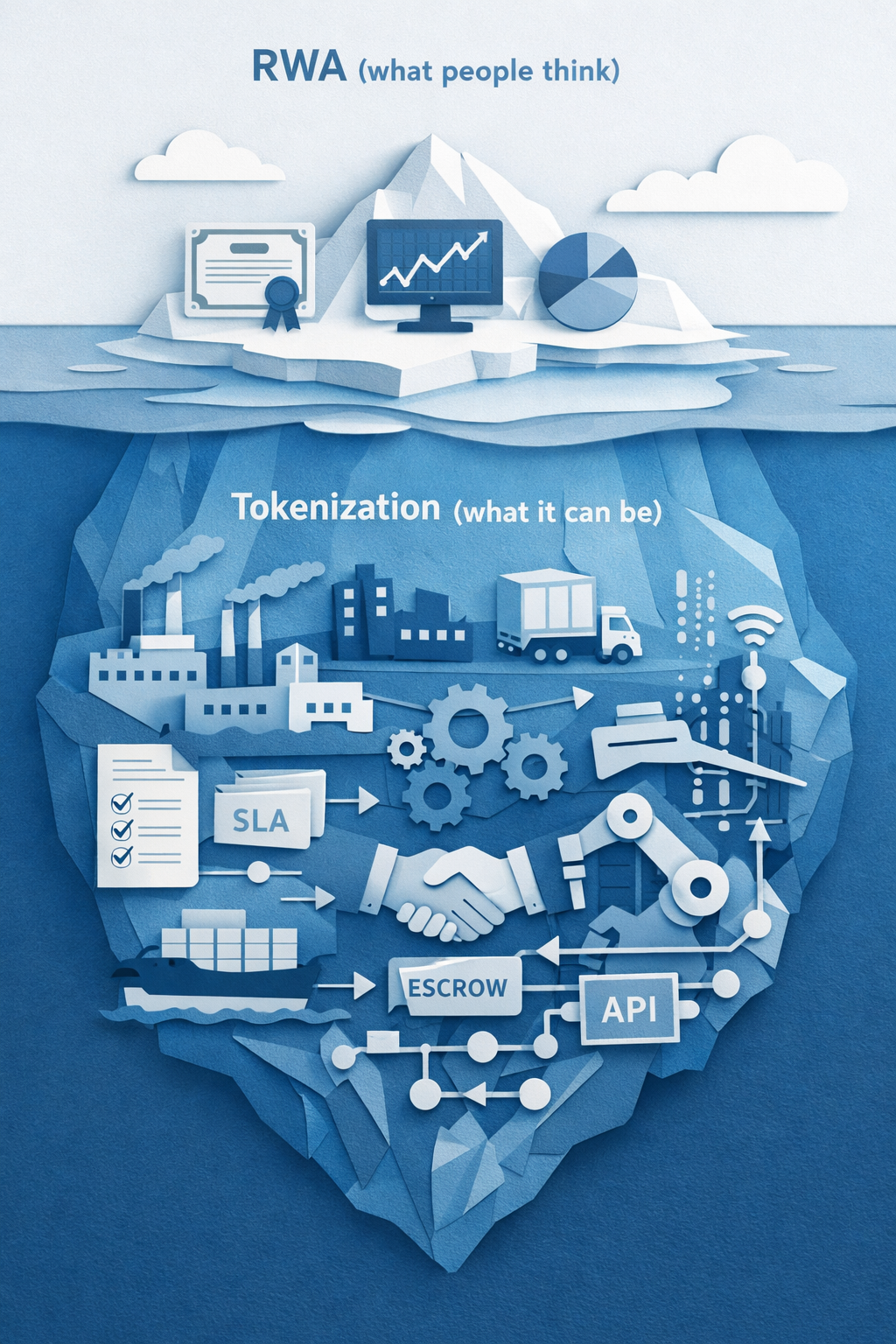
If you ask most people what “real-world asset tokenization” (RWA) is, you’ll get a narrow answer:
“Putting stocks, bonds, funds, and maybe real estate on-chain.”
And if you ask what tokenization could be, a different answer appears:
“Making any good or service programmable — so business-to-business commerce becomes composable, automatable, and settlement-native.”
Both are “tokenization.” But they live in totally different mental universes.
So why does the public narrative obsess over tokenized Treasuries and equity wrappers… while the much larger prize — tokenizing how the economy actually works — gets treated like science fiction?
Let’s unpack the disconnect, quantify it, and then sketch a future where “tokenization” stops meaning “financial PDFs on-chain” and starts meaning “the economy as executable code.”
1) The gravitational pull of what already exists: instruments, not flows
RWA conversations are dominated by institutions whose business model is built around financial instruments: banks, asset managers, custodians, brokerages, exchanges, and the compliance-industrial complex orbiting them.
Their native question is:
“Which existing security can we represent digitally, without changing its legal nature?”
That naturally produces:
- tokenized Treasuries
- tokenized money-market funds
- tokenized private credit
- tokenized funds and structured products
This is tokenization as wrapping.
It’s not because they lack imagination. It’s because their incentives, regulatory perimeter, distribution channels, and revenue lines are already tuned for “securities-shaped things.”
2) The headline numbers reinforce the bias (even though they hide the real opportunity)
Consider the sheer scale of traditional instrument markets:
- Debt securities outstanding topped $150 trillion by end-2024, and exceeded 135% of global GDP.
- World GDP in 2024 was about $111 trillion (current USD).
If you combine those with global equity values, you get the impression that “the big pools of value” are in stocks and bonds so tokenization must mean tokenizing those.
Even “market cap as % of GDP” gets quoted like a mic drop; the World Bank tracks global market cap as a share of GDP.
So in people’s minds:
“Tokenization = investment assets.”
But here’s the catch:
stocks and bonds are not “the economy.”
They’re claims on the economy.
The economy itself is mostly work, production, delivery, uptime, logistics, guarantees, and settlement — things that don’t show up as neat tickers.
3) What the economy actually does all day: trade, services, obligations
A useful lens is flows vs. stocks.
- Stocks: accumulated claims (bonds outstanding, equity market value)
- Flows: continuous commerce (goods shipped, services delivered, invoices paid, contracts fulfilled)
In 2024, world trade in goods and commercial services was about $32.2 trillion.
That’s not even counting huge volumes of domestic B2B commerce, payroll, procurement, and internal enterprise settlement that never crosses a border. Trade statistics are just the visible tip.
And those flows are messy:
- purchase orders
- invoices
- milestones
- service-level agreements
- late delivery penalties
- warranties
- escrow
- partial acceptance
- chargebacks
- disputes
- reconciliation
This is where tokenization’s “bonds-and-stocks narrative” starts to look oddly narrow.
4) The core misunderstanding: tokenization ≠ fractionalization
Most popular explanations unconsciously reduce tokenization to a single concept:
“Fractional ownership of something expensive.”
That frames tokenization as:
- splitting an asset
- selling pieces
- enabling new investors
- improving liquidity
All valid.
But that’s not the big thing.
The bigger thing is:
Tokenization = making obligations and transfers machine-executable.
That changes the story from “who owns what” to “what happens next.”
Think of the difference between:
-
a tokenized bond: “you own a claim”
vs - a tokenized service contract: “the claim settles itself when performance is verified”
One is a digital wrapper.
The other is an automated
economic process.
5) Why the “workflow” version of tokenization feels invisible
(A) Regulation has boxes for securities, not for dynamic commerce
Regulators know how to supervise:
- disclosures
- custody
- investor protections
- market manipulation rules
- settlement cycles
They have fewer clean frameworks for:
- machine-triggered obligations
- data-driven payouts
- multi-party workflow contracts
- “economic state machines” where value unlocks conditionally
So the industry gravitates to the safest thing you can explain in a single sentence:
“It’s like a bond, but on-chain.”
(B) Incumbents benefit from the mess
A lot of enterprise value capture comes from:
- reconciliation
- intermediated settlement
- invoice financing layers
- disputes and chargeback machinery
- opaque pricing and delayed cash conversion
“Tokenized workflows” reduce friction and friction is where many middlemen get paid.
(C) Narratives follow distribution channels
The loudest narrative spreads through:
- funds
- exchanges
- crypto markets
- investor media
- “yield” dashboards
Those channels naturally amplify investable assets, not contract automation.
6) The reframe: smart contracts are better at process than “assets”
Here’s a simple reframe that collapses the whole dichotomy:
A bond is a very simple workflow.
- collect principal
- pay coupon
- return principal
A modern economy is made of workflows that are:
- conditional
- multi-party
- partial
- data-driven
- dispute-prone
Smart contracts are not just “ownership records.” They are workflow engines with money rails.
Once you see that, “tokenization” expands to include:
- pay-per-use machinery (verified output → automatic payout)
- tokenized procurement (PO → invoice → acceptance → settlement)
- escrow-by-default marketplaces
- tokenized warranties and maintenance contracts
- licensing and royalties with automatic revenue splits
- insurance-like guarantees that settle from telemetry
This is tokenization as execution.
7) Quantifying the “how much larger” claim (without hype)
Let’s ground the “bigger than bonds” vision in conservative logic:
- Global debt securities outstanding: $150T+ (a stock of claims).
- Global trade flows (goods + services): $32.2T in 2024 (a yearly flow).
- Global GDP: ~$111T in 2024 (total yearly output).
Even if only a slice of GDP is realistically “programmable settlement” in the near term (B2B procurement, services, logistics, performance contracts, licensing), that slice is still enormous, recurring, and operationally painful today.
In other words:
- Tokenizing bonds attacks a big stock of assets (important).
- Tokenizing commerce attacks a massive recurring flow (transformational).
The former improves market infrastructure.
The latter changes how businesses behave.
8) A vision of the future: “The economy becomes APIs”
In the next phase, tokenization stops being a finance product and becomes a business primitive.
Phase 1: Tokenized wrappers (today)
- tokenized Treasuries for yield
- tokenized funds for distribution
- tokenized private credit for access
Value: faster settlement, composability, 24/7
rails
Limitation: still depends on legacy processes and
legal wrappers
Phase 2: Tokenized obligations (near future)
Businesses tokenize commitments, not just assets:
- “deliver X units by date Y”
- “maintain uptime above 99.95%”
- “produce output above threshold”
- “refund automatically if SLA fails”
- “release payment when acceptance criteria met”
What changes: cash conversion cycles shrink, disputes drop, settlement becomes event-driven.
Phase 3: Autonomous commerce (agents + telemetry)
AI agents negotiate and execute contracts continuously:
- procurement bots buy inputs when inventory crosses thresholds
- manufacturing cells get paid per verified output
- logistics routes get priced dynamically (with penalties enforced automatically)
- insurance settles from sensor data without claims paperwork
What changes: markets become continuous; businesses become composable modules.
This is the world where tokenization is not “assets on-chain.”
It’s the operational economy becoming programmable.
9) The one-liner that captures the whole thing
Tokenizing bonds is putting financial claims on-chain.
Tokenizing goods and services is putting the economy on-chain.
That’s the dichotomy.
And it explains the disconnect: most people are staring at the familiar, regulated, investable corner of the map — while the bigger territory (workflows, obligations, and machine-executable commerce) still looks like uncharted land.
10) What to watch for (signals the narrative is shifting)
You’ll know we’re crossing the bridge when “tokenization” headlines stop being about yield products and start being about:
- enterprise procurement networks using smart-contract settlement
- telematics-driven payouts (energy, logistics, manufacturing)
- tokenized warranties, licensing, and revenue-share automation
- dispute resolution becoming a protocol layer
- accounting systems treating smart-contract events as primary ledger entries
When that happens, the RWA acronym will feel too small.
Because the real thing being tokenized won’t be “assets.”
It will be economic behavior.
Originally published on Medium.